Widening Doorways for Wheelchairs and Walkers A Complete Guide
Practical modifications for safety and independence
Making your home accessible doesn't mean giving up the home you love. It means making it work better for the next 20 years. Widening doorways is one of the most impactful modifications you can make, and there are options for every budget and timeline. Most standard doorways are 32 inches wide. Wheelchairs need 36 inches minimum, and walkers work better with 34-36 inches. The good news: you have several approaches, from $20 solutions you can try this weekend to full renovations that create the space you need.
About costs and timeline: Modification costs vary by complexity and location. Start with the most essential changes first and plan for professional installation of structural modifications.
1
Start with What You Have: $20-100 Solutions
Remove the door entirely
$0–20 · Beginner · DIY
The fastest way to gain 2-3 inches of clearance is to take the door off its hinges and store it. This works well for bedroom doors, bathroom doors when privacy isn't essential, and any interior door that stays open most of the time. You can reinstall the door later if needed. If you want some separation without the door, hang a curtain rod in the doorway and use a lightweight curtain. ### Install Swing-Clear Hinges
Install swing-clear hinges
$15–40 per door · DIY
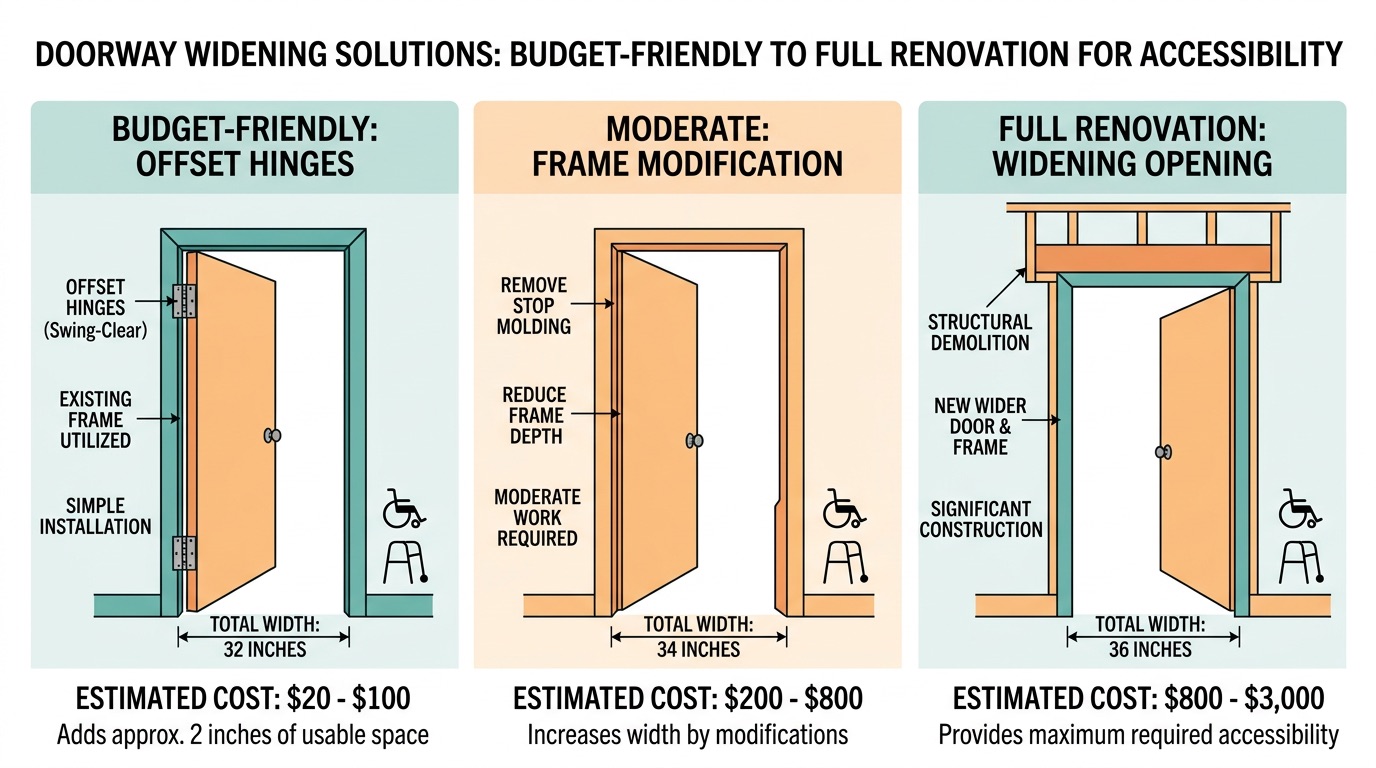
Standard hinges keep the door inside the frame opening when it swings. Swing-clear hinges move the door completely out of the opening, giving you an extra 1.5-2 inches of clearance. These hinges work on existing doors and frames. You remove the old hinges and screw in the new ones using the same holes. The door looks and functions normally but provides more space when open. ### Replace the Door with a Narrower One
Replace with a thinner door
$80–200 · DIY or professional
If your current door is a standard 1.75-inch thick door, you can replace it with a 1.375-inch door. This gains you about half an inch on each side. Combined with swing-clear hinges, you can gain 2.5-3 inches total. Hollow-core doors in the thinner profile are available at home improvement stores. The frame stays the same. You just need a door that fits your existing frame height and a slightly narrower width.
Start with What You Have: $20-100 Solutions visual guide
2
Mid-Range Solutions: $200-800
Cost: $200-500 · Professional recommended
Mid-Range Solutions: $200-800
A contractor can remove the door trim (the decorative wood around the frame) and cut back the door frame itself by 1-2 inches on each side. This gives you 2-4 inches of additional width while keeping the structural integrity of the wall. This approach works best when you only need a few extra inches and the wall isn't load-bearing. The contractor will need to patch and paint the wall where the old trim was attached. ### Install an Offset Hinge System
Cost: $150-400 · Professional installation
Mid-Range Solutions: $200-800
Offset hinges mount the door further back into the frame opening, similar to swing-clear hinges but with more adjustment. These systems can gain you 2-4 inches depending on the frame depth. This is a good middle option when removing the door isn't practical but you need more clearance than standard swing-clear hinges provide.
Mid-Range Solutions: $200-800 visual guide
3
Full Doorway Widening: $800-3000 per Opening
Widen a non-load-bearing wall
$800–1,500 per doorway · Professional
For interior walls that don't support the structure above them, a contractor can widen the opening by cutting into the wall framing. This typically involves removing drywall, cutting studs, installing a new header, and rebuilding the frame to your desired width. Most bedroom walls, bathroom walls, and walls between living spaces are non-load-bearing. The contractor can usually tell by looking, but may need to check the house plans or consult a structural engineer. ### Load-Bearing Wall Modification
Widen a load-bearing wall
$1,500–3,000 per doorway · Professional
Walls that support the weight of the floor or roof above need special handling. The contractor will install a beam (called a header) to carry the load across the wider opening. This requires permits in most areas and sometimes an engineer's approval. Load-bearing walls typically run perpendicular to floor joists and often sit directly under other walls or beams on the floor above. Your contractor can identify these and explain the requirements for your specific situation.
Full Doorway Widening: $800-3000 per Opening visual guide
4
What This Investment Gets You
Key Tips
Start with the most important modifications first based on your current needs.
Consider both immediate safety and future accessibility when making changes.
Get multiple quotes from qualified contractors for major modifications.
Check with your insurance about coverage for medically necessary modifications.